
Optical Spectrum 64QAM Signal. Download Scientific Diagram

Abstract. The fundamental modulation methods used in 5G NR are Pi/2 BPSK, QPSK, 16-QAM, 64-QAM, and 256-QAM. Those used in Wi-Fi 6 are BPSK, QPSK, 16-QAM, 64-QAM, 256-QAM and 1024-QAM. That used in Bluetooth 5 is GFSK. These are the methods, therefore, that we are going to briefly review in this chapter. For all but GFSK, the modulation is such.
Rejeter Association magnifique modulation qam 64 Circulaire Camarade Théorie de base
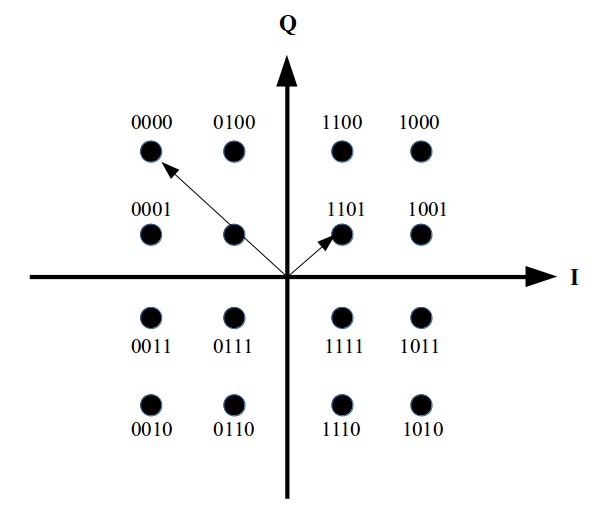
The 64 QAM and 256 QAM are used in digital cable television and cable modem. QAM is used in optical fiber systems to increase bit rates. It is used in many communication systems like Wi-Fi, Digital Video Broadcast (DVB), and WiMAX.
Figure 6 from CQI table design to support 256 QAM in small cell environment Semantic Scholar

The DOCSIS spec says a modem must be able to operate at +/- 15db rx power. Obviously, modems closer to 0db have the best signal and the most amount of headroom. The data rate for 64 QAM is 30.34 Mbps, and the data rate for 256 QAM is 42.88 Mbps. There's overhead associated with the DOCSIS protocol itself so 256 QAM downstreams are realistically.
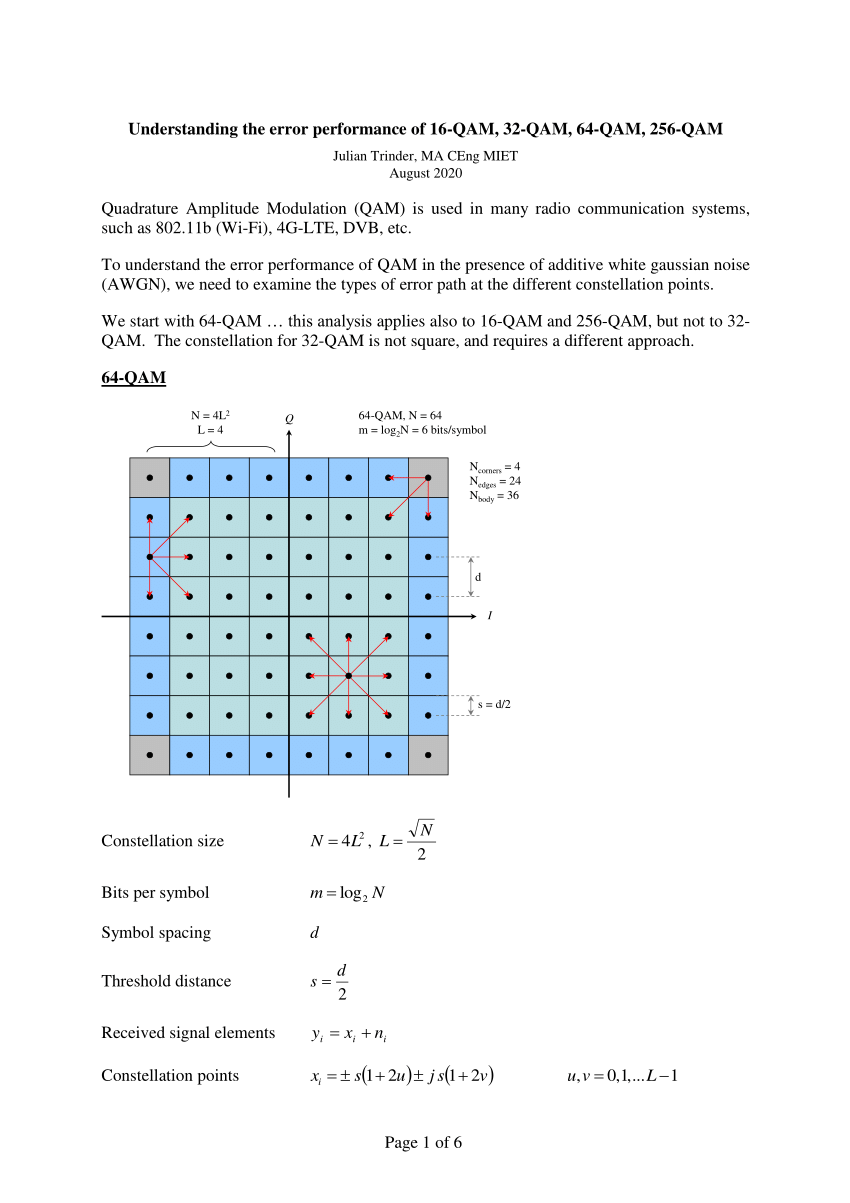
(PDF) Understanding the error performance of 16QAM, 32QAM, 64QAM, 256QAM
It packs 33% more data into the signal than 64-QAM. The significance of 256-QAM is the availability of two new data rates, MCS 8 and MCS 9. These achieve higher throughput than the previously highest data rate of MCS 7, in the same amount of airtime. Needless to say, all big number claims for 802.11ac presume 256-QAM is being used.
Radiation pattern of a signal with 64 BS antennas and 256QAM modulation Download Scientific

As one might expect, 256-QAM is better than 64-QAM and 64-QAM is better than 16-QAM because the higher QAM numerology reflects the ability to represent more data with the same number of symbols. "Since with the binary notation each data bit is either a 1 or a 0, 256-QAM can theoretically support eight bits per symbol, thanks to the 256 unique.
PSK and QAM Modulation Schemes
For example 256-QAM is complex than 16-QAM. QAM is more bandwidth efficient compare to BPSK but it is less robust. Hence for better CINR in the system QAM is employed which leads better data rate. For poor CINR, BPSK is employed. CINR stands for Carrier to Interference and Noise Ratio. Tabular difference between 16-QAM, 64-QAM and 256-QAM.
5G NR Hierarchical 64QAM constellation diagram Download Scientific Diagram

256-QAM is a type of Quadrature Amplitude Modulation (QAM) in which a carrier wave of constant frequency can exist in one of 256 different discrete and measurable states in the constellation plot. The constellation diagram consists of two axes namely the in-phase (X-axis) and Quadrature (Y-axis). Both the in-phase and quadrature axes of the modulated signal are orthogonal to each other i.e. 90.
BPSK, QPSK, 64QAM, and 256QAM Modulation The Hungry Penguin

A variety of forms of QAM are available and some of the more common forms include 16 , 32 , 64 , 128 and 256 QAM. Here the figures refer to the number of points on the constellation, i.e. the number of distinct states that can exist. The various flavours of QAM may be used when data-rates beyond those offered by 8-PSK are required by a radio.
Fiber reservoir computing for 16,64, and 256QAM signal processing.... Download Scientific

For example, for filtered 16-QAM, 64-QAM, and 256-QAM, this ratio is on the order of 6 to 7 dB, 7 to 8 dB, and 8 to 9 dB, respectively. Thus, power amplifiers processing these signals must operate at an average power that is backed off from the peak linear power available by a minimum of the peak to average ratio of the amplified signal.
64/256QAM TCM Decoder. Download Scientific Diagram

The analysis reveals that higher-order modulations, such as 64-QAM and 256-QAM, offer higher data rates and improved spectrum efficiency compared to 16-QAM. Furthermore, the study investigates the spectrum performance of the O-NOMA waveforms. The results indicate that higher-order modulations may utilise the spectrum more efficiently.
BER performance of 802.11ah with 16QAM, 64QAM, and 256QAM using AWGN... Download Scientific

256-QAM. 256-QAM, or Quadrature Amplitude Modulation with 256 states, is the most advanced modulation scheme used in Wi-Fi. It allows for even higher data transfer speeds than 64-QAM, but is more susceptible to noise and interference. It is used in high-speed Wi-Fi networks, such as those based on the 802.11ac and 802.11ax standards.
PPT Sweep Overview PowerPoint Presentation, free download ID1741556

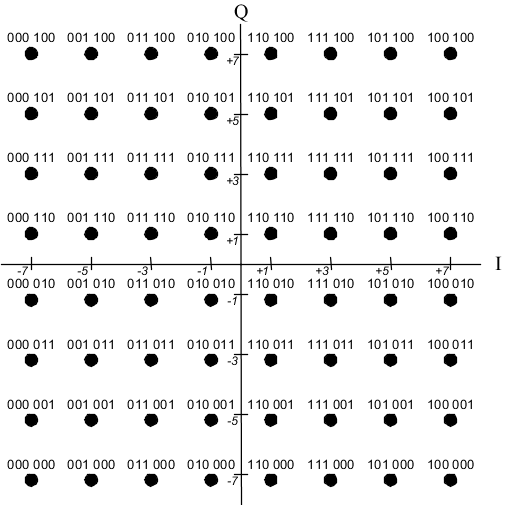
64-QAM is a type of Quadrature Modulation (QAM) in which a carrier wave of a fixed frequency can exist in one of sixty-four different discrete and measurable states in the constellation plot. The constellation plot consists of two component axis namely the in-phase (X-axis) and quadrature (Y-axis). The two components are orthogonal to each other or 90˚ out of phase with respect to each other.
256 QAM Constellation Diagram

A MCS basically defines the following two aspects: Modulation. Code rate. Modulation. Modulation defines how many bits can be carried by a single RE irrespective of whether it's useful bit or parity bits. 5G NR supports QPSK, 16 QAM, 64 QAM and 256 QAM modulation . With QPSK there are 2 bits can be transmitted per RE, with 16QAM it can be 4.
5(a) 256QAM modulation and demodulation system model Download Scientific Diagram

For example, 64-QAM is a QAM scheme with 64 symbols, and 256-QAM is a scheme with 256 symbols. 256-QAM conveys 8 bits per symbol (as 256 = 2 8), so achieving twice the data rate of 16-QAM for the same symbol rate. Activity 1.7 Self assessment. How many bits are represented by each symbol in 64-QAM? Sketch a constellation diagram for 64-QAM.
10 QPSK, 16QAM, and 64QAM constellation. Download Scientific Diagram

Following are the benefits or advantages of QAM: The major benefit of QAM modulation variants is efficient usage of bandwidth. This is due to the fact that QAM represent more number of bits per carrier. For example, 16QAM maps 4 bits per carrier, 64QAM maps 6 bits per carrier, 256QAM maps 8 bits per carrier and so on.
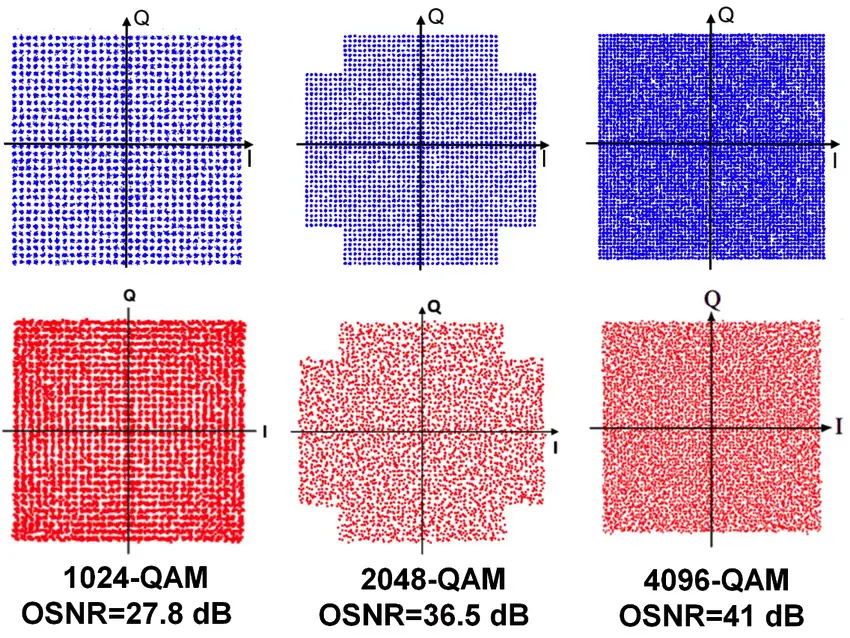
1K QAM vs. 4K QAM Why it matters for WiFi 7
5.1 Introduction. The fundamental modulation methods used in 5G are Pi/2 BPSK, QPSK, 16-QAM, 64-QAM, and 256-QAM. These are the methods, therefore, that we are going to study in this chapter, along with some issues involved in their realization. In these methods, baseband signals linearly modulate an RF carrier.